Posts

Showing posts with the label Ads

Pop Artifice

Image
Target has been around since 1959, when its first store opened in the Roseville, Minnesota, a suburb just north of St. Paul.  And for much of next four decades, its advertising was practical, safe, and largely forgotten as soon as the ad ended.     But during the mid-90s, things started changing. It began with the chain's very conscious positioning of itself as a “discounter unlike other discounters,” typified by the theme, "Expect more. Pay less." And when Target broke into the East Coast market, opening a store in Menlo Park, New Jersey,  in  1996, they turned to New York agency Kirchenbaum and Bond, who gave them a striking campaign that married household products to fashion, and helped make Target a favorite of fashionistas.   So the stage was set for Minneapolis agency, Peterson Milla Hooks, to make Target's next leap. Dubbed the “ Sign of the Times ” campaign, it turned their red bullseye logo into a design element in all of their advertising, combini...

Who is Mr. Thomson and why can't he keep his hands to himself?

Image
An oddly intriguing 1960s-era campaign I stumbled across recently.  Let’s handle this part right up front: Obviously, seen through modern eyes, it’s sexist as all get-out – but if you just want to reinforce your disgust at the ads, there are other web sites out there that will indulge you.    Here, I’m more interested in examining these ads as an  ad campaign  – what made them attention-getting, recognizable, and endlessly reproducible, as well as how they channeled the zeitgeist (for better and worse). So who is this Mr. Thomson with the audacity to feature himself as a handsy designer of women’s apparel?    The internet is surprisingly barren when it comes to The Thomson Company , the textile manufacturer behind the ads, the brand, and the exclamation – but digging deep, here’s what I’ve been able to find out and suss out. Though he was the public face (so to speak) of the company, our Mr. Thomson was, in fact, an advertising creation, as fictitious ...

The caveman at mid-century

Image
The mid-century, it seems, was the heyday for advertising that traded on the trope of the caveman dragging off a mate by her locks.  As eye-catching, evocative imagery, it was just too potent for ad men to resist -- especially when it could be presented with an anachronistic twist. Thus, we have this 1949 Arrow ad which gives women the upper hand in the mating ritual, informing us that "A man hasn't a chance in an Arrow White Shirt."    "Correct, young-man-about-to-live-in-a-cave!" the copy confirms, "Their handsome, perfect-fitting collars are irresistible." (And don't worry about their mismatched clothing. By the time she's finished dragging him home, that white shirt will be a memory, in dirty, ragged shreds.) In 1956, the scenario again made an appearance, with men and women back in their traditional roles, this time to cast bone-ribbed girdles as something out the stone age ... or something very much like it. "Come out of the bone age...

"Thinking Too Hard" essay: Zeitgeist brands

Image
What's a Zeitgeist brand? Find out in this essay   –  which you can listen to me read or just read on your own  –  from my book, "Thinking Too Hard and Rethinking Too Much: Stories and Essays from a Career in Advertising." Craig McNamara 3 · Zeitgeist Brands by Craig McNamara Every once in a while, the right brand appears at just the right time, when larger events in the world or culture add a special resonance to the product. To me, they're "Zeitgeist Brands" – after the German word that translates to "spirit of the age." It's one of the most powerful marketing tools available, but almost by definition, it's one of the most unpredictable. Hard to create and usually impossible to duplicate. Sometimes it happens by accident, but it can be planned, too. Apple's 1984 TV spot, for example, played off the cultural fascination with reaching the titular year of Aldous Huxley's dystopian novel. But that was more about making ...

Storytelling in advertising, reincarnated

Image
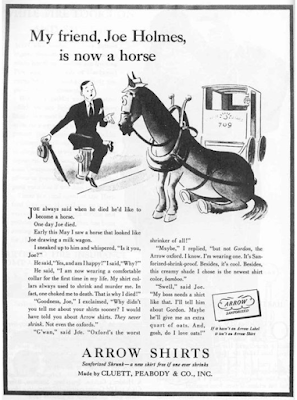
We know storytelling is all the rage now in marketing. And like most fashionable things, there’s usually some precedent in the past. Why else do we have the phrase, “Everything old is new again”? Still, you’re not likely to come across a story today like the one in this 1938 Arrow Shirts ad. If authenticity is all, this is more, well, horseplay: It was written by  George Gribbin  of Young & Rubicam, who was  recalled  as saying,  "One of the great assets of this agency is that a man here feels he can express himself as a writer."  Certainly, he accomplished that here; sixty years later, the ad was still well remembered, ranking 98 th  of the Top 100 Ads according to Advertising Age magazine in 1999. It begins,   Joe always said when he died, he’d like to become a horse.    One day Joe died.    Early this May, I saw a horse that looked like Joe drawing a milk wagon. “I sneaked up to him and whispered, “Is it you, Joe?” ...

I wanted to like this ad, I really did

Image
When I first came across it, I (wrongly) assumed it was the work of Doyle Dane Bernbach, using a very minimalist layout to catch attention and evoke emotion, sort of like they did with the Polaroid ads in the ‘60s . No logo, just a simple headline, and an intriguing illustration that tells you nothing about the product, only the elation it will inspire in the woman in the your life. What an incredible way to portray a woman leaping into the arms of her man, I thought, showing only what’s necessary to imply the situation, spurring the reader to imagine the embrace, the eyes, the kiss.   Brilliant, I thought. Then I read the headline.    “Wear an Arrow Shirt and you'll simply sweep her off her feet!”   No.   No, I don’t believe this ad, even for a minute.    The only way to sell this scenario is if the emotion implied feels true. Even in 1949, it’s hard to imagine anyone got this excited about a dress shirt. Unless he just got home from the service and t...

Rebranding a movie

Image
It’s not unusual for a product to undergo rebranding. In fact, one of the most successful was covered on this very blog .    But in this case, the product in need of a new image wasn’t found on a store shelf. It was projected on the silver screen.   In 1973, United Artists released its movie,  The Long Goodbye  to theatres in Los Angeles, Chicago, Philadelphia and Miami. The movie re-teamed director Robert Altman and star Elliot Gould of the box-office hit  M*A*S*H  three years earlier, in an adaptation of the Raymond Chandler noir novel.    “Nothing says goodbye like a bullet,” the movie poster announced, Elliot Gould brandishing a cigarette and pistol, looking as hard-boiled as Humphrey Bogart’s Marlowe in 1946’s  The Big Sleep.   And the audience stayed away in droves.    When the limited release ended, United Artists pulled the film from its next opening in New York and, baffled by the apathy of audiences (and the host...

Making the ad space part of the ad concept

Image
Yes, yes, I know, print advertising is dead, especially newspaper advertising – but ads still use space in other mediums, so apply these observations as you will.   Make the height of the ad part of the concept Look how this 1966 Mobil ad really sells the comparison of car collision at 80 mph with the impact of a car dropped from a ten-story building. You could have used a rooftop shot of the car going over; you could have shown a tighter shot of a car falling past a row of windows; you could have shown the crushed car at the base of the building; but Len Sirowitz of Doyle Dane Bernbach used the height of the newspaper space to show the full size of building, inviting us the imagine the long fall of the automobile and what happens when it hits the ground. And making a static photo feel as dramatic as the same demonstration in the accompanying TV commercial .    (The layout is even more brilliant when you consider that the ad was likely encountered by people reading the ne...