Posts

Showing posts with the label ad agencies

Pop Artifice

Image
Target has been around since 1959, when its first store opened in the Roseville, Minnesota, a suburb just north of St. Paul.  And for much of next four decades, its advertising was practical, safe, and largely forgotten as soon as the ad ended.     But during the mid-90s, things started changing. It began with the chain's very conscious positioning of itself as a “discounter unlike other discounters,” typified by the theme, "Expect more. Pay less." And when Target broke into the East Coast market, opening a store in Menlo Park, New Jersey,  in  1996, they turned to New York agency Kirchenbaum and Bond, who gave them a striking campaign that married household products to fashion, and helped make Target a favorite of fashionistas.   So the stage was set for Minneapolis agency, Peterson Milla Hooks, to make Target's next leap. Dubbed the “ Sign of the Times ” campaign, it turned their red bullseye logo into a design element in all of their advertising, combini...

Doing the Shark Dance

Image
So there I was, on the sands of a Florida beach, surrounded by a group of young people in swimwear, all eyes on me as I instructed them in the dance they were about to perform. The dance I was still coming up with barely five minutes earlier. The Shark Dance.   In 1994, I was a writer at an ad agency in Minneapolis, where one of my projects was the launch of that year’s Tigershark personal watercraft models made by Arctic Cat. Along with writing the ads and brochure, I would be going down to Florida to help supervise the film shoot of people riding Tigersharks in the gulf.    That included a riff on  Jaws , where beachgoers are panicked by a kid yelling “Shark!” as he spots a guy on a Tigershark. And later, the four Tigershark models zooming left to right across the screen, followed by a large shark fin we had made that was pulled through the water on a submerged rig. The fin was convincing enough that two riders unconnected to our shoot darted over and started yelli...

Storytelling in advertising, reincarnated

Image
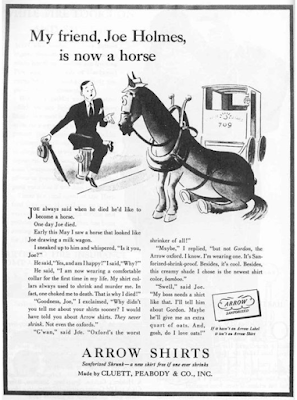
We know storytelling is all the rage now in marketing. And like most fashionable things, there’s usually some precedent in the past. Why else do we have the phrase, “Everything old is new again”? Still, you’re not likely to come across a story today like the one in this 1938 Arrow Shirts ad. If authenticity is all, this is more, well, horseplay: It was written by  George Gribbin  of Young & Rubicam, who was  recalled  as saying,  "One of the great assets of this agency is that a man here feels he can express himself as a writer."  Certainly, he accomplished that here; sixty years later, the ad was still well remembered, ranking 98 th  of the Top 100 Ads according to Advertising Age magazine in 1999. It begins,   Joe always said when he died, he’d like to become a horse.    One day Joe died.    Early this May, I saw a horse that looked like Joe drawing a milk wagon. “I sneaked up to him and whispered, “Is it you, Joe?” ...

Making the ad space part of the ad concept

Image
Yes, yes, I know, print advertising is dead, especially newspaper advertising – but ads still use space in other mediums, so apply these observations as you will.   Make the height of the ad part of the concept Look how this 1966 Mobil ad really sells the comparison of car collision at 80 mph with the impact of a car dropped from a ten-story building. You could have used a rooftop shot of the car going over; you could have shown a tighter shot of a car falling past a row of windows; you could have shown the crushed car at the base of the building; but Len Sirowitz of Doyle Dane Bernbach used the height of the newspaper space to show the full size of building, inviting us the imagine the long fall of the automobile and what happens when it hits the ground. And making a static photo feel as dramatic as the same demonstration in the accompanying TV commercial .    (The layout is even more brilliant when you consider that the ad was likely encountered by people reading the ne...

Happiness is a warm television

Image
Authentic. Genuine. Truthful. These are the qualities above all that modern advertising aspires to – or claims to aspire to. Consumers today are too savvy, too cynical, the thinking goes, to be beguiled by unrealistic depictions and unattainable expectations. Yet despite this emphasis on realism, advertising largely remains an aspirational medium. Even the earthiest, unadorned people you see in ads still tend to be stylishly photographed and romanticized, still appealing to how we wish to see ourselves, even if that wish is a bit less lofty.  So unlike the scrubbed, idealized images Madison Avenue sold us during the ‘50s and ‘60s. And that’s largely true – but when it comes to authenticity, nothing I’ve seen in recent years comes close to this mid-1960s campaign for Sony’s new concept of “portable” televisions. Created by the celebrated “Think small”/”When you’re number two, you try harder” ad agency, Doyle Dane Bernbach , these 1965 ads present something that's largely vanished fr...

Lois and Ogilvy on The Big Idea

Image
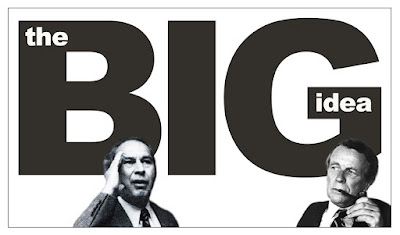
As a panelist on a TV talk show, ad man and creative revolutionary George Lois was once asked to define advertising. After listening to the more scholarly definitions offered up the other ad execs on the panel, George commented, “I think these guys and me are in a different business,” and offered a more blunt, visceral definition.    Lois:  “Advertising is poison gas. It should bring tears to your eyes. It should unhinge your nervous system. It should knock you out.” 1   That’s George in a nutshell. Visceral. Bombastic. But in a less provocative mood, he summed his approach up this way:    Lois:  “The common denominator of all my work is the unremitting quest for The Big Idea, because The Big Idea – a surprising solution to a marketing problem, expressed in memorable verbal and/or graphic imagery – is the authentic source of communicative power … [and] picks up force and speed because its element of surprise changes a habit or point of view.” 2 He capi...

Bill Stein: Critters & Creatures

Image
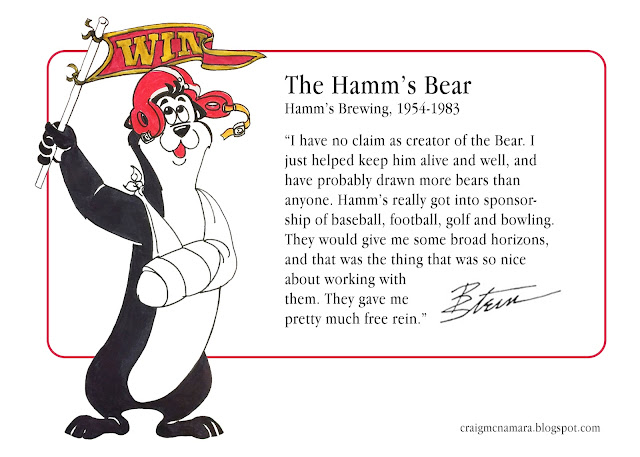
In 2016, I was helping my father-in-law, commercial artist Bill Stein (1923- 2020), prepare for a move by sorting through his flat files of artwork and sketches accumulated over his 60+ year career. Lots of Hamm’s work, naturally, and a drawer filled with Inky Lou posters. But there were other critters and creatures, too – animal and human, whimsical and fantastical.  I hadn't realized how many times Bill had to help brand a company through the personality and antics of an advertising mascot. I put together a booklet for him, "Critters & Creatures," that compiled examples of the characters that Bill had drawn (and in several cases, created), along with his brief memories about each of them. This is my introduction to the collection, along with four of the best-known mascots. * * * In the world of advertising, they’re known as “critters,” the popular pitchmen of the Leo Burnett Company . The Chicago ad agency was behind such 20th Century marketing icons as Tony the Ti...

Ogilvy vs. Bernbach

Image
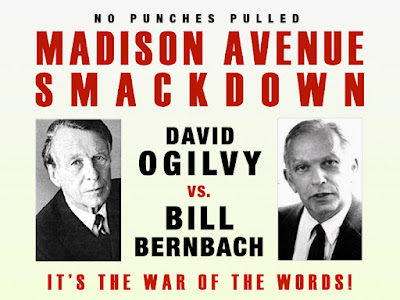
What follows is a completely rewritten version of a post written for this blog over a decade ago; same viewpoint, just better expressed. Appropriately, it's one of the essays in my book, Thinking Too Hard and Rethinking Too Much: Stories and Essays from a Career in Advertising . If there was anything new to be gained from the [then] recent passing of advertising legend David Ogilvy, founder of Ogilvy & Mather, I hope it will be a long-overdue re-evaluation by my generation of his ideas and principles about advertising.     Oh sure, the industry press carried the expected pronouncements of admiration from various creative superstars, but in nearly every case, it ran along the lines of “the quintessential ad man, built up a darn big agency” – backhanded compliments that discredited his actual creative accomplishments, if only by omission.     Trust me, I understand. I was here in the 80’s, the decade of  Ogilvy On Advertising , the book wherein Mr. O...

The Customers Get the Last Laugh

Image
It’s not what you put into your ad, it’s what the audience takes away from it In his recent autobiography,  All About Me , writer, filmmaker, and occasional actor, Mel Brooks, talks about the one fight he had with Gene Wilder on the set of their 1974 movie,  Young Frankenstein . It was over the scene where Dr. Frankenstein introduces his creature to the medical community with an absurd song-and-dance to  Puttin’ on the Ritz .   “It was Gene’s idea and I told him I thought it was a great idea and very funny, but it was too far out … I insisted it was too silly and would tear the continuity of the movie to pieces. … we almost got into a fistfight because of it.”   Finally, Brooks agreed to film the scene and test it on a preview audience. When the audience loved it, Brooks happily conceded, “Gene, you were absolutely right. Not only does it work, but it may be one of the best things in the whole movie … it took the movie to another level. We left satire and made ...