Posts

Showing posts with the label Commercials

Doing the Shark Dance

Image
So there I was, on the sands of a Florida beach, surrounded by a group of young people in swimwear, all eyes on me as I instructed them in the dance they were about to perform. The dance I was still coming up with barely five minutes earlier. The Shark Dance.   In 1994, I was a writer at an ad agency in Minneapolis, where one of my projects was the launch of that year’s Tigershark personal watercraft models made by Arctic Cat. Along with writing the ads and brochure, I would be going down to Florida to help supervise the film shoot of people riding Tigersharks in the gulf.    That included a riff on  Jaws , where beachgoers are panicked by a kid yelling “Shark!” as he spots a guy on a Tigershark. And later, the four Tigershark models zooming left to right across the screen, followed by a large shark fin we had made that was pulled through the water on a submerged rig. The fin was convincing enough that two riders unconnected to our shoot darted over and started yelli...

"Thinking Too Hard" essay: Zeitgeist brands

Image
What's a Zeitgeist brand? Find out in this essay   –  which you can listen to me read or just read on your own  –  from my book, "Thinking Too Hard and Rethinking Too Much: Stories and Essays from a Career in Advertising." Craig McNamara 3 · Zeitgeist Brands by Craig McNamara Every once in a while, the right brand appears at just the right time, when larger events in the world or culture add a special resonance to the product. To me, they're "Zeitgeist Brands" – after the German word that translates to "spirit of the age." It's one of the most powerful marketing tools available, but almost by definition, it's one of the most unpredictable. Hard to create and usually impossible to duplicate. Sometimes it happens by accident, but it can be planned, too. Apple's 1984 TV spot, for example, played off the cultural fascination with reaching the titular year of Aldous Huxley's dystopian novel. But that was more about making ...

Making the ad space part of the ad concept

Image
Yes, yes, I know, print advertising is dead, especially newspaper advertising – but ads still use space in other mediums, so apply these observations as you will.   Make the height of the ad part of the concept Look how this 1966 Mobil ad really sells the comparison of car collision at 80 mph with the impact of a car dropped from a ten-story building. You could have used a rooftop shot of the car going over; you could have shown a tighter shot of a car falling past a row of windows; you could have shown the crushed car at the base of the building; but Len Sirowitz of Doyle Dane Bernbach used the height of the newspaper space to show the full size of building, inviting us the imagine the long fall of the automobile and what happens when it hits the ground. And making a static photo feel as dramatic as the same demonstration in the accompanying TV commercial .    (The layout is even more brilliant when you consider that the ad was likely encountered by people reading the ne...

"Hosting" a recording session – 3 things I learned from Garry Marshall

Image
Recently, I was re-reading  Wake Me When It’s Funny , 1  the 1995 memoir by Garry Marshall , famed sitcom creator/producer ( Happy Days ,  The Odd Couple ,  Mork & Mindy ) and movie director ( Pretty Woman ,  The Flamingo Kid ,  Beaches ). Along with anecdotes from shows and films throughout his career, Marshall dispenses little bits of pragmatic advice on working – and surviving – in show business.  But I’ve found his advice often applicable to working – and surviving – in advertising, too. Especially when it comes to recording voices for commercials and videos.   Tip #1:  "Host" the recording session “I want everyone to get along while they're working because I hate tension while I'm working,” Marshall wrote. “One way to do this is to make each person feel as if he's one of the most important players on the team.” That’s why Michael Eisner, former Paramount and Disney CEO, said that "Garry Marshall doesn't direct a movie. He hosts a mov...

Bob & Ray, Ad Men Extraordinare

Image
During their 5 decades of performing together on radio and TV programs, Bob Elliot and Ray Goulding have portrayed befuddled newsmen, quirky interview subjects, didactic soap opera characters another media mainstays.  But of all the targets of their deadpan, underplayed style, one the best has been their commercial parodies.  Sure, that sounds like faint praise, what with the glut of commercial parodies all over TV and the internet these days, but Bob & Ray appropriated the language of advertising with an insightfulness that's easy to miss while you're laughing at their off-kilter dialogue. Their commercials for fictitious sponsor Monongahela Metal Foundry -- "Casting Steel Ingots With The Housewife In Mind"  -- make a mockery of advertisers' attempts at consumer relevance.    Their Einbinder Flypaper slogan -- "The Brand You've Gradually Grown To Trust Over The Course Of Three Generations" -- was a typical heritage-hyping appeal and yet resonat...

Lois and Ogilvy on The Big Idea

Image
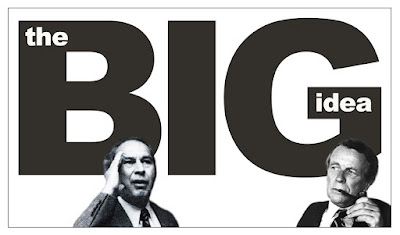
As a panelist on a TV talk show, ad man and creative revolutionary George Lois was once asked to define advertising. After listening to the more scholarly definitions offered up the other ad execs on the panel, George commented, “I think these guys and me are in a different business,” and offered a more blunt, visceral definition.    Lois:  “Advertising is poison gas. It should bring tears to your eyes. It should unhinge your nervous system. It should knock you out.” 1   That’s George in a nutshell. Visceral. Bombastic. But in a less provocative mood, he summed his approach up this way:    Lois:  “The common denominator of all my work is the unremitting quest for The Big Idea, because The Big Idea – a surprising solution to a marketing problem, expressed in memorable verbal and/or graphic imagery – is the authentic source of communicative power … [and] picks up force and speed because its element of surprise changes a habit or point of view.” 2 He capi...

The Customers Get the Last Laugh

Image
It’s not what you put into your ad, it’s what the audience takes away from it In his recent autobiography,  All About Me , writer, filmmaker, and occasional actor, Mel Brooks, talks about the one fight he had with Gene Wilder on the set of their 1974 movie,  Young Frankenstein . It was over the scene where Dr. Frankenstein introduces his creature to the medical community with an absurd song-and-dance to  Puttin’ on the Ritz .   “It was Gene’s idea and I told him I thought it was a great idea and very funny, but it was too far out … I insisted it was too silly and would tear the continuity of the movie to pieces. … we almost got into a fistfight because of it.”   Finally, Brooks agreed to film the scene and test it on a preview audience. When the audience loved it, Brooks happily conceded, “Gene, you were absolutely right. Not only does it work, but it may be one of the best things in the whole movie … it took the movie to another level. We left satire and made ...

Gorilla or Guerrilla?

Image
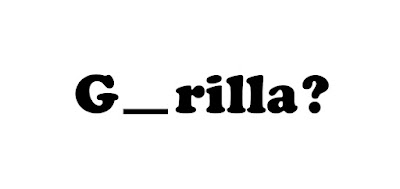
An interesting error I've seen made more than once in this business:  In emails or memos that reference the tactic of "guerrilla marketing" – eschewing traditional media for unconventional, attention-getting, and relatively cheaper message placements – the unknowing writer has misspelled it as  gorilla  marketing.   That, ironically, brings to mind the old "800-pound gorilla" designation for the biggest, most powerful brand in a given industry – one whose advertising budgets dwarfed their competitors' miniscule marketing dollars and thus had little for need for the cleverness of guerrilla advertising.   The term, incidentally, was coined by author Jay Conrad Levinson in his 1984 book,  Guerrilla Marketing . He based it, of course, on the concept of guerrilla warfare, i.e, small independent groups using ambush, surprise, and mobility to effectively battle against larger forces.    Going back one step further, guerrilla is derived from the Spanish w...

What's it like to work in advertising? It's like this.

Image
What's it like to create advertising for a living? What’s it like to work at an ad agency?  What’s to like – or not like – about certain ad campaigns?  What do I like in how advertising in portrayed in movies and TV?   Find out here, in essays, articles, podcast scripts, and blog posts – nothing too heavy and written with wit and style.  Like the writing on this blog?  It's like that, and more. $9.99 softcover – $4.99 ebook Read excerpts and order  here .

Embracing (but not squeezing) Mr. Whipple

Image
"It was that easy. In an hour and a half, America's most universally despised advertising campaign was created." That's how Benton & Bowles writer John Chervokas described the process of creating Mr. Whipple and the "Please Don't Squeeze the Charmin!" ad campaign in 1964. Mr. Chervokas died not too long ago, leaving as his legacy an ad campaign that was rated by Advertising Age as the 51st best campaign of the last century. By 1978, Mr. Whipple was named the third-best-known American—just behind former President Nixon and Billy Graham. “Please don’t squeeze the Charmin!” became one of most recognizable advertising slogans ever, identified by eight out of 10 people that same year. And yet, far from celebrating Mr. Whipple, the advertising community frequently derided Mr. Chervokas' brainchild as emblematic of the crass, lowest-common denominator pandering for which the industry was often denounced. (And judging by the title of a popular manual o...

More real people, unscrubbed

Image
Back in my first post in January 2008, I showed this ad , as an example of the recognition (and celebration) of "real people" that's been absent in modern advertising (except as a source of humor, over-romanticism and post-modern irony). Here's another ad I recently discovered from that same campaign: Contrast that with this spot two decades later. Similar laundromat setting, a similar depiction of an overweight laundromat lady (around :46) -- but here, she -- and the others -- are just used as visual shorthand for the prim, traditional sensibilities our counter-cultural jeans-washer offends: