Posts

Showing posts with the label Pop Culture

The focus group loses focus

Image
Although Santa Claus has been around in different forms for centuries, much of how we think of that Jolly Old Elf today was established in 1822 by Clement Clark Moore’s poem, “’Twas The Night Before Christmas.”   But what would Santa Claus be like if he was created today?  How would today’s culture shape his personality and modus operandi?   First, let’s consider Santa himself: an older, whiskered, rotund fellow.  This is never going to fly (so to speak). After all, ours is a society that worships youth and is obsessed with fitness. As for the facial hair, well, maybe if you’re Paul Bunyan, okay, but not for someone on whose lap we’re going to place little Dylan and Brittany. He’ll have to lose the beard, a few pounds and a lot of years.   And isn’t Santa just a little too much of goody two-shoes for today’s tastes?  Sure, we still want heroes, but we like them a bit less than pure. Makes them easier to relate to. So let’s give him a rough ex...

Red-Nosed Drunk

Image
A hoof banged on the bar. “Hit me again, Joe.”   “Don’t you think you’ve had enough for one night, pal?” the bartender replied coolly.  “I can smell the nut meg on your breath from here.”   “Hey, my nose always is always red,” Rudolph snorted back. “I can handle my egg nog.”   “Something bothering you, Rudy?”   The reindeer lowered his dewy eyes to the bar. “Sorry, Joe. It’s the holiday, you know? Sometimes, it just gets me down. All this rampant commercialism, the runaway materialism. I mean, where’s it going to end?"    “Isn’t your attitude a little hypocritical, Rudolph? You know, given where you came from.”   “What are you talking about?” the reindeer snorted. His nose momentarily flared bright red in the smoky dimness of the bar, as if inflamed by his annoyance.   The bartender considered his next words carefully. “You know about Montgomery Wards, right? The department store? Some copywriter there made you up for a giveaway booklet ...

"Hosting" a recording session – 3 things I learned from Garry Marshall

Image
Recently, I was re-reading  Wake Me When It’s Funny , 1  the 1995 memoir by Garry Marshall , famed sitcom creator/producer ( Happy Days ,  The Odd Couple ,  Mork & Mindy ) and movie director ( Pretty Woman ,  The Flamingo Kid ,  Beaches ). Along with anecdotes from shows and films throughout his career, Marshall dispenses little bits of pragmatic advice on working – and surviving – in show business.  But I’ve found his advice often applicable to working – and surviving – in advertising, too. Especially when it comes to recording voices for commercials and videos.   Tip #1:  "Host" the recording session “I want everyone to get along while they're working because I hate tension while I'm working,” Marshall wrote. “One way to do this is to make each person feel as if he's one of the most important players on the team.” That’s why Michael Eisner, former Paramount and Disney CEO, said that "Garry Marshall doesn't direct a movie. He hosts a mov...

Just re-do it

Image
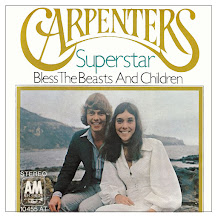
What’s your favorite song by The Carpenters? That would seem to be a simple enough question – but when it comes to the ‘70s sister-and-brother duo, it can be a little more complicated. Because often, you don’t just have to choose a song, you have a choose a version. Richard Carpenter didn’t just sing harmony to his Karen’s lead vocals. As producer,  arranger, lyricist, and composer, he was deeply involved in the production of the tracks – and a bit of a perfectionist. So over the years, as their hits have been re-released, he’s used the opportunity to remix many tracks  to improve sound quality and add new instrumentation and flourishes – on songs like  Ticket to Ride ,  Top of the World , and  Superstar . And it hasn't been just Richard Carpenter re-doing works long after they’ve been completed. Think of Neil Sedaka, re-recording his 1962 bubblegum hit,  Breaking Up is Hard To Do  as a soulful piano ballad in 1975. Or the group Chicago, re-arranging t...

Binge/Purge TV

Image
I’ve been known to sum up my past co-dependent relationship with television by telling others that my parents used to say, “It’s such a nice day, Craig – why don’t you take the TV outdoors?”   Yes, I’m exaggerating – but only a little. I freely admit, I watched way too much TV growing up. Given that, you might think our modern era of “Peak TV, with streaming services multiplying like rabbits on Spanish Fly, would be a dream come true for me, right?    Let’s press pause and think about that for a second.   Now, don’t get me wrong, I’m all for the freedom to consume entertainment programs on my own schedule without having to wait a week between installments or broken up by commercials. And I won’t argue the point that we’re in a Second Golden Age of Television, with more shows than ever before of high quality, diverse subject matter, and involving storytelling – The Sopranos, Mad Men, Breaking Bad, Game of Thrones, et al.   But here’s the thing: If you’ve ever own...

I've seen this movie [poster] before...

Image
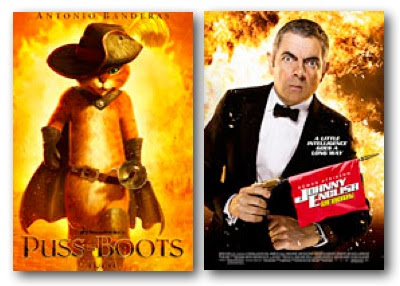
Yes, every summer now brings us a spate of formula movies that we all feel like we've already seen at least one time before. But now it seem that even the movie posters themselves are interchangeable. I've covered one of the more common motifs before here and here . But here are some of the more current poster layouts: The main action-hero character in front of an exploding fireball... The big X... The fragmented, David Hockneyesque photo collage... The mysterious movie-title-only-on-a-dramatic-black-background... The big intriguing closeup with the title stamped over it... The weird two-half-faces joined to make a single face... The action-hero looking battered but unbowed, weapon in hand... A guy slouching in a chair, legs splayed... The shoulder-to-shoulder heroes, with the bigger star out front... The sideways poster with black silhouette and steely blue sky... And finally, the whole gang, striding purposefully at camera... And that's just from a couple recent intern...

Keeping informed and carrying on

Image
I am fascinated by this simple piece of communication from the British government: Today, the message seems almost like a parody of the British "stiff upper lip" -- probably the reason that reproductions of the poster have become so popular since it resurfaced in 2000 -- but there's a surprising sense of urgency and resolve behind that basic sans-serif typeface and its iconic crown image. To put it in true context, you need only to realize that it this poster was created by the Ministry of Information in 1939 at the beginning of World War II with the intent of strengthening the morale of the British public in the event of an invasion by Germany. Try to imagine, if you can, the uncertainty and panic you'd feel when faced with the possibility that your country, your city -- very neighborhood -- could soon be under control of a foreign military. What would you do? Who could you trust? How would you stay safe? These are the kind of life-or-death questions this poster had ...

The (near) naked truth

Image
You combine with the loosening sexual mores of 1972 with the mainstreaming of the "male centerfold" (following movie star/sex symbol Burt Reynolds appearing au natural in Cosmopolitan that same year) and this -- unfortunately -- is what you get: Real socks appeal, fellas. Yes, what better way to show off your socks than by removing all those other distracting clothes? Or, more to the point, what better way to draw attention to your ad than by highlighting it in context of one of the most provocative images allowed in mainstream media of the era? (Showing women nude or with implied nudity had been fairly common in advertising since at least the '50s .) But back to the Cosmo influence: After some 80 years as a family magazine, then-new editor Helen Gurley Brown reoriented the magazine in the early 1970s, to a focus on the interests of sexually liberated young women. Women finally get equal rights to objectify the opposite sex. Probably nothing epitomized the magazine...

Sundown and shadows

Image
Yes, hard liquor is most respectably consumed in the evening hours, but is there something more behind this 1972 Smirnoff ad's imploring headline? Is it a reference to the 1967 racially charged drama, " Hurry Sundown "? Or perhaps the spiritual made popular by folkies Peter, Paul and Mary in 1966? Actually, I'm guessing it's neither, and instead was just a clever intro into the ad's recipe for the "Vampire Gimlet," so dubbed, I suppose, for its eerie green hue and black olive. But that raises a new question, doesn't it? Why a vampire? This was, after all, decades before the romantic vampire imagery of '80s and '90s cinema and television. In fact, Ah, but the clue is in the ad's photo, the modern-but-still-vaguely-gothic appearance of the woman in the window. The drink, as well as the ad, seems calculated to appeal to the youth-adult audience that had helped catapult this unique ABC soap opera -- and its vampiric leading man, Barna...

Those crazy teenagers...

Image
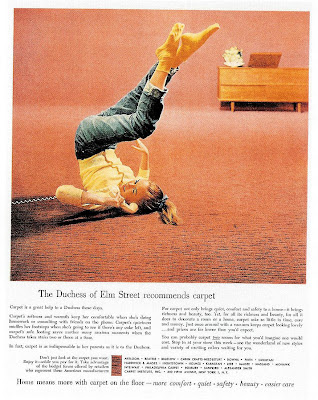
This seems to be the default pose to use when picturing Those Crazy Teens in the '50s... I guess her pose is supposed to symbolize the playfulness and nonconformity of youth, and perhaps the rejection of the staid societal norms of the previous generations. Then again, maybe she's just wearing antigravity socks. Actually, in the 1956 ad above, her inverted body actually serves the product in that it shows how comfortable it is to lie directly on a carpeted floor. The same pose is also found in this 1951 ad, coupled with some hip teen lingo to show how "with it" Post Toasties are, Daddio: The pose probably reached its apotheosis in 1963, when uber-teen Ann Margaret lolled on her back for all of America to publicize the movie version of "Bye Bye Birdie."

What's really behind the smoke?

Image
Here's an early-1970s ad that seems to have sparked a lot of "outrageously outrageous outrage" on some sites around the web: "It's rude/it's sexist/it's unhealthy" goes the shocked, shocked criticism of this ad -- which, seen in the context of the times, seems as about as pointless as sneering at it for its pro-smoking advocacy. What I found interesting was reference point for the headline. "Blow in her face and she'll follow you anywhere" wasn't just referring to the fruit-flavored tobacco (which, the ad presumes, she'll find aromatic). It's a paraphrasing of a catchy come-on -- "Blow in my ear and I'll follow you anywhere" -- that was popularized by 1969's and 1970's #1 TV show, " Laugh-In ." Used as both a pickup line and a punchline, I seem to recall even Dick Martin using it in his routines with partner Dan Rowan. Finally, before we leave this Tipalet ad behind, in its defense, may I...

Picking a fight over female boxers

Image
It's a thin thread on which to hang this presumption, but is there something more behind this 1979 ad than just a pugilistic image to represent tougher nails? Now, I admit that the idea of casting an ad model as a boxer wasn't new, and pre-dated even the post-women's lib era, as seen in this 1961 Maidenform ad : But is it merely a coincidence that 1979 was also when this Barbra Streisand movie was released, and became one of the year's top grossing movies? (And yes, the only time Streisand's character got in the ring was to verbally spar with the fighter she "owned," played by Ryan O'Neil -- but as the poster above makes clear, the movie's publicity all about putting Ms. Streisand into boxing imagery.)

Where's Gladys?

Image
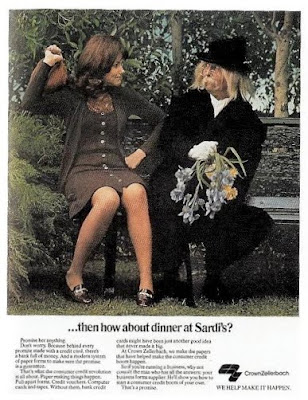
This one's too easy. A 1974 ad from paper manufacturer Crown Zellerbach: "Promise her anything," the ad begins, assuring the reader that "behind every promise made with a credit card...there's a modern system of paper forms to make sure the promise is a guarantee." (This is pre-analog and pre-digital transmission of data.) All well and good, I suppose, but what, you're wondering, is the point with the photo and headline? Actually, if you were watching TV back in the early '70s, you already know what the point is. The photo is a clumsily staged knock-off of a popular " Laugh-In " skit featuring series regulars Ruth Buzzi and Arte Johnson: Here's how Wikipedia explains it: ...dowdy spinster Gladys Ormphby, clad in drab brown with her bun hairdo covered by a visible hairnet knotted in the middle of her forehead. In most sketches, she used her lethal purse, with which she would flail away vigorously at anyone who incurred her wrath. On ...

Things go better with Santa

Image
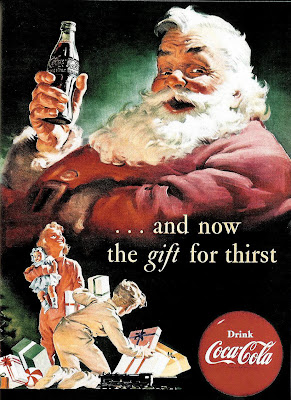
Recognize this jolly gent? If so, you can thank (in part) the Coca-Cola company, whose 1930s holiday ads illustrated by Haddon Sundblom helped popularize the image of Santa as a rotund, ruddy elf dressed in red from head to toe. Thanks for your visits in 2010. The deconstructing will continue in 2011. Happy New Year!

Koss, the Owl & the Pussycat

Image
What's going on in this 1971 ad from Koss? Is it a couple of middle-agers dabbling in the '60s sexual revolution, and ending up indulging other passions instead (his, high-brow music, hers low-brow TV and bon-bons)? "No two people really enjoy all the same things," the ad begins. "What turns one on may very well turn the other off." And so we get that staple of the '60s movie and TV relationships, the sexed-up woman and the oblivious man. The innuendo aside, it's an interesting choice for portraying domestic differences. Assuming it even is a domestic scene. Who's to say it isn't some misguided post-coital scene of a, shall we say, more professional transaction? It's up the reader to decide, but I'm pretty sure the ad creators were inspired by this hit movie from the year before: " The Owl and the Pussycat " was based on a Broadway play (and not the 1871 children's poem by Edward Lear) and adapted to a film starring...