Posts

Remembering Riney

Image
The ad industry lost another legend this week.  There isn't much I can add to this obituary for Hal Riney , who passed away at the age of 75, except to say that -- in addition to all the success his commercials brought to Saturn cars, the Reagan re-election campaign and Bartles & Jaymes wine coolers, among other clients --  probably the highest compliment he's earned is this:  In advertising circles, during the '80s and '90s, his name alone became synonymous with the style of advertising he was most famous for.  When you'd say to your partner, "let's do a Hal Riney spot," you both knew what that meant -- a montage of warm images of Americana, sweet, soft music and an laid-back announcer expounding on the simple virtues of life  (and that was usually the cue to attempt your best Hal Riney impression, since his distinctive voice narrated many of his best spots). Like this one: Yes, the "Hal Riney" spot, in the hands of its imitators became...
Imagine yourself here

Image
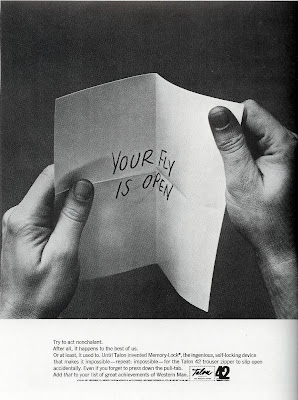
Pulling the reader into your ad as an almost active participant can result in some very effective communication. This 1960s-era ad makes it easy to imagine yourself in the same embarrassing situation:

What hath Joe wrought?

In his commercials for FedEx, Dunkin Donuts, Wendy's and more during the 1980s, director Joe Sedelmaier specialized in hilarious, deadpan portrayals of put-upon time-clock punchers and timid middle-management types, with a humor that was equal parts Bob & Ray, Benny Hill and the Carol Burnett Show. Yet despite our laughing at them, not with them, there was always something human and relatable in his charactatures, a strange affection for the foibles and travails of the common nine-to-fiver. Of course, success breeds imitation, especially in advertising. But like any copy machine, the imitations always seem to duplicate only the surface characteristics,  never the warmth underneath.  Like this recent spot: Ask yourself:  Does this spot make you feel any affinity for CareerBuilder?  (Did they ask themselves that?)

Tell me a story

Image
With its graphic simplicity and bare-bones copy, this 1970 Betty Crocker ad seems about 30 years ahead of its time. But it's more than just the visual puns so common in ads today. The old saying goes that one picture is worth 1,000 words; here, the photo is so evocative in its storytelling, the ad gets by with just twenty-seven: "Everything is in this new buttermilk pancake mix -- even egg and shortening. All you add is water to bake up golden fluffy pancakes or crisp hearty waffles." The unusual setting, the bedraggled figure, the obvious irony and the implied frustration combine for an ad that makes its simple point in a memorable way. One can easily imagine how it stood out alongside the more typical food ads in the pages of Better Homes & Gardens and Ladies Home Journal.

The perfect word

Image
One of the under-appreciated skills of the best copywriting is the precision of the wording, especially in headlines. With so much of current "professional" advertising falling into labored attempts at humor and wordless visual puns, it's good to remember to power of, not just words, but well-chosen words. In the ad above, created sometimes during the '60s by the agency Papert Koenig Lois, George Lois recalls that the initial inspiration for this ad's headline read this way: If your Harvey Probber chair is crooked , straighten the floor." See the difference. In its first generation, the headline is somewhat at odds with the client's message of precision-built furniture. The phrase, "If your chair is crooked" implies that the defect is in the chair. Changing the wording to "If your chair wobbles" is more neutral towards the chair, and helps reinforce the idea that the floor is at fault. Incidentally, the heavy red/brown color sc...

Which came first? The movie or the ad? (Part 2)

Image
The British Twix campaign ran in 2005.  America's "Lars and the Real Girl" was released in 2007, but interestingly, was written (by former "Six Feet Under" scribe Nancy Oliver) at least two years previously, when it gained attention as one of the most-liked unproduced scripts in Hollywood.   I'd chalk it up to pure coincidence, though. Ms. Oliver credits her inspiration here as being a "what if" musing, i.e., What if we treated our mentally ill with kindness and compassion? -- two qualities which are not evident in the Twix ad (or, strangely enough, in the movie poster). (Read part one here .)

Is he the father of modern advertising?

Image
That's right.  Him.  David Letterman.  Those of us who are over 40, think about it for a second (the rest of you are going to have to take our word for it).  So much of the post-modern creativity evident in advertising today can be traced back to NBC's "Late Night with David Letterman." The snarky too-cool-for-school attitude; the sarcastic ad-speak; the humor at the expense of the product, the "we all know this is bullsh*t" undercurrents; the knowing winks at the viewer; the lampooning of other commercials; the influence Dave and his group of writers had on the current generation of creative people has been substantial. And don't get me started on the endless Top Ten list knock-offs.