Posts

The inevitable Charlie Sheen-inspired post (but it's not what you think!)
Image
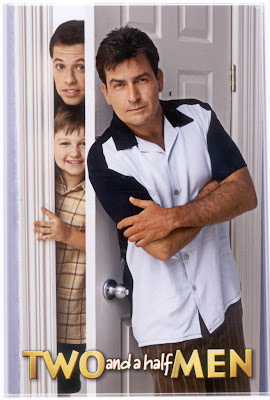
Running alongside an article on Mr. Sheen and his recent...happenings, I noticed this promotional image for his CBS sitcom. Look familiar: Yes, it's another example of that popular comedic image we were discussing just a couple weeks back, Bickering-Parties-On-Either-Side-Of-A-Door . I also stumbled on this other example recently... More proof that what the exposed brick wall is to comedians, the multi-paneled door is to comedies.

The (near) naked truth

Image
You combine with the loosening sexual mores of 1972 with the mainstreaming of the "male centerfold" (following movie star/sex symbol Burt Reynolds appearing au natural in Cosmopolitan that same year) and this -- unfortunately -- is what you get: Real socks appeal, fellas. Yes, what better way to show off your socks than by removing all those other distracting clothes? Or, more to the point, what better way to draw attention to your ad than by highlighting it in context of one of the most provocative images allowed in mainstream media of the era? (Showing women nude or with implied nudity had been fairly common in advertising since at least the '50s .) But back to the Cosmo influence: After some 80 years as a family magazine, then-new editor Helen Gurley Brown reoriented the magazine in the early 1970s, to a focus on the interests of sexually liberated young women. Women finally get equal rights to objectify the opposite sex. Probably nothing epitomized the magazine...

He is the very model of the modern advertising man (2011 version)

Image
Hawkeye Pierce is so last millennium. Back in 2008, I posited that Alan Alda's portrayal on the M*A*S*H series was the idealized image of how creative people in advertising view themselves: witty, irreverent, iconoclastic, hedonistic, slovenly and eccentric, but also capable and confident, dedicated and dependable, principled, tenacious, and when the chips were down, absolutely brilliant. But really, that was an image taken from an earlier era, when even flawed characters were always primarily defined by their inherent decency. The richer, more complex characters of television today provides an ever better template for those anguished souls battling for creative integrity in ad agencies: Meet Dr. House : Yes, another doctor (because don't we all view the creative process as a matter of life and death?) -- but while Hugh Laurie's Dr. House is as undeniably brilliant, intuitive and typically unshaven as Dr. Pierce, the similarities end there. Dr. Gregory House is impatien...

Going the distance and looking backwards

Image
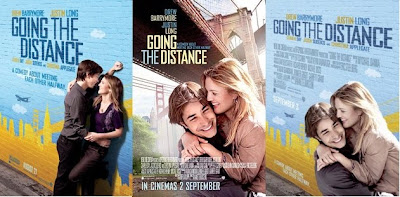
When the Drew Barrymore/Justin Long movie, " Going The Distance " came out last year, it seems the studio couldn't quite make up their mind on the right poster. Was it going to be Drew and Justin getting cozy against a brick wall, hugging under the Brooklyn Bridge, or a combination of the first two options? Well, it's safe to say that none of the options above did much to sell the picture, since it only grossed an anemic $40 million worldwide (versus a $32 million production budget and probably at least half that in marketing costs) during its run -- which is probably why the DVD sports a whole new image that seems to sell it as a more wacky comedy using one of the modern tropes of movie poster imagery... Yes, it's "the bickering people separated by a door" scenario, a setup that promises conflict, frustration, and lots and lots o' laughs (in theory, anyway). It's possible the studio remembered the graphics for 1996's Jamie Lee Curtis/Kevin...

Sundown and shadows

Image
Yes, hard liquor is most respectably consumed in the evening hours, but is there something more behind this 1972 Smirnoff ad's imploring headline? Is it a reference to the 1967 racially charged drama, " Hurry Sundown "? Or perhaps the spiritual made popular by folkies Peter, Paul and Mary in 1966? Actually, I'm guessing it's neither, and instead was just a clever intro into the ad's recipe for the "Vampire Gimlet," so dubbed, I suppose, for its eerie green hue and black olive. But that raises a new question, doesn't it? Why a vampire? This was, after all, decades before the romantic vampire imagery of '80s and '90s cinema and television. In fact, Ah, but the clue is in the ad's photo, the modern-but-still-vaguely-gothic appearance of the woman in the window. The drink, as well as the ad, seems calculated to appeal to the youth-adult audience that had helped catapult this unique ABC soap opera -- and its vampiric leading man, Barna...

Those crazy teenagers...

Image
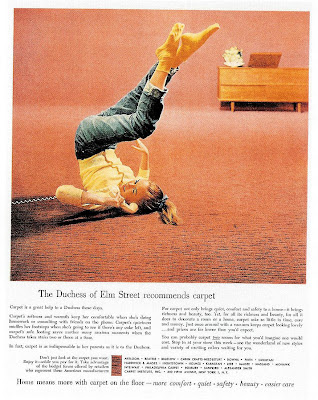
This seems to be the default pose to use when picturing Those Crazy Teens in the '50s... I guess her pose is supposed to symbolize the playfulness and nonconformity of youth, and perhaps the rejection of the staid societal norms of the previous generations. Then again, maybe she's just wearing antigravity socks. Actually, in the 1956 ad above, her inverted body actually serves the product in that it shows how comfortable it is to lie directly on a carpeted floor. The same pose is also found in this 1951 ad, coupled with some hip teen lingo to show how "with it" Post Toasties are, Daddio: The pose probably reached its apotheosis in 1963, when uber-teen Ann Margaret lolled on her back for all of America to publicize the movie version of "Bye Bye Birdie."

What's really behind the smoke?

Image
Here's an early-1970s ad that seems to have sparked a lot of "outrageously outrageous outrage" on some sites around the web: "It's rude/it's sexist/it's unhealthy" goes the shocked, shocked criticism of this ad -- which, seen in the context of the times, seems as about as pointless as sneering at it for its pro-smoking advocacy. What I found interesting was reference point for the headline. "Blow in her face and she'll follow you anywhere" wasn't just referring to the fruit-flavored tobacco (which, the ad presumes, she'll find aromatic). It's a paraphrasing of a catchy come-on -- "Blow in my ear and I'll follow you anywhere" -- that was popularized by 1969's and 1970's #1 TV show, " Laugh-In ." Used as both a pickup line and a punchline, I seem to recall even Dick Martin using it in his routines with partner Dan Rowan. Finally, before we leave this Tipalet ad behind, in its defense, may I...