Thinking outside the 'board
A pretty clever 2005 outdoor board that uses more than just the ad space to draw attention to itself and help make its point.
Labels: Ads, Creativity
Craig McNamara blogs and podcasts about advertising and working in advertising
A pretty clever 2005 outdoor board that uses more than just the ad space to draw attention to itself and help make its point.
Labels: Ads, Creativity
The ad industry lost another legend this week. There isn't much I can add to this obituary for Hal Riney, who passed away at the age of 75, except to say that -- in addition to all the success his commercials brought to Saturn cars, the Reagan re-election campaign and Bartles & Jaymes wine coolers, among other clients -- probably the highest compliment he's earned is this: In advertising circles, during the '80s and '90s, his name alone became synonymous with the style of advertising he was most famous for. When you'd say to your partner, "let's do a Hal Riney spot," you both knew what that meant -- a montage of warm images of Americana, sweet, soft music and an laid-back announcer expounding on the simple virtues of life (and that was usually the cue to attempt your best Hal Riney impression, since his distinctive voice narrated many of his best spots). Like this one:Labels: creative people, Icons
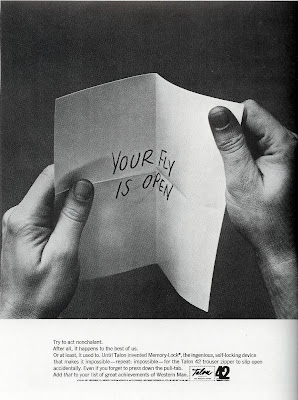
Pulling the reader into your ad as an almost active participant can result in some very effective communication. This 1960s-era ad makes it easy to imagine yourself in the same embarrassing situation:
Labels: Ads, Creativity
In his commercials for FedEx, Dunkin Donuts, Wendy's and more during the 1980s, director Joe Sedelmaier specialized in hilarious, deadpan portrayals of put-upon time-clock punchers and timid middle-management types, with a humor that was equal parts Bob & Ray, Benny Hill and the Carol Burnett Show.
Labels: Ads, creative people
With its graphic simplicity and bare-bones copy, this 1970 Betty Crocker ad seems about 30 years ahead of its time. But it's more than just the visual puns so common in ads today. The old saying goes that one picture is worth 1,000 words; here, the photo is so evocative in its storytelling, the ad gets by with just twenty-seven:"Everything is in this new buttermilk pancake mix -- even egg and shortening. All you add is water to bake up golden fluffy pancakes or crisp hearty waffles."The unusual setting, the bedraggled figure, the obvious irony and the implied frustration combine for an ad that makes its simple point in a memorable way. One can easily imagine how it stood out alongside the more typical food ads in the pages of Better Homes & Gardens and Ladies Home Journal.
Labels: Ads, Creativity

In the ad above, created sometimes during the '60s by the agency Papert Koenig Lois, George Lois recalls that the initial inspiration for this ad's headline read this way: If your Harvey Probber chair is crooked, straighten the floor."Labels: Ads, Creativity


Labels: Ads, creative people, Creativity, Icons
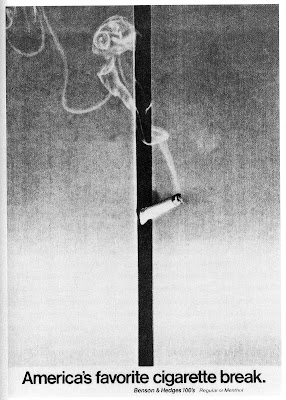
Four years after the popular Benson & Hedges campaign broke, the ads were still running, but in culture and fashion, there was a huge difference between 1967 and 1971, as the ad below demonstrates:

Labels: Ads, Creativity
Faced with advertising a "longer than king-size" cigarette, Wells Rich Greene did the unthinkable in cigarette advertising: they mutilated the product. Benson & Hedges featured bent and broken cigarettes caused by smokers unaccustomed to the added length. Humor wasn't new in advertising, but it was in cigarette advertising and best of all, the humor was all based on the product's selling point, so the message always got through. In print:
Labels: Ads, Creativity, Marketing
Before founding the agency that carried her name, Mary Wells Lawrence was part of Jack Tinker & Partners, where she was first recognized for bringing a theatricality to advertising, a more cinematic and story-driven approach to selling. Given the fledgling Braniff account, Ms. Wells re-introduced the carrier to the world by breaking out or the dull monochrome world that air travel was circa 1965. She splashed color outside and inside the planes and outfitted the "hostesses" (sorry, the "flight attendant" name was still years away) in stylish Emilio Pucci designs.
Labels: Ads, creative people, Icons, Marketing

Labels: Ads, Creativity
This is the California Milk Processor Board campaign, begun in 1993.
Here's a little quiz for all you marketing geniuses out there. Watch the commercial and see if you can you spot the genius behind it?
"We met a doctor...who demonstrated to us that in order for aspirin to break through the pain barrier it often required two aspirins, not one, to do the job. As aspirin is one of the ingredients that make Alka-Seltzer effective, we asked if two Alka-Seltzers were better than one. Yes, two would work better than one."
With this information, Ms. Wells convinced the client to change the usage directions to specify two tablets and began packaging them in pairs. Accordingly, they changed the advertising to always show two Alka-Seltzer tablets dropping into the water. And to make sure consumers started thinking in twos (and remember the overall benefit), the message was very effectively reinforced by the musical couplet, "Plop, plop, fizz, fizz / Oh, what a relief it is."Labels: creative people, Icons, Marketing
The product demonstration is one of advertising's most venerated tactics, and has taken many forms over the decades. Here's the latest generation: One simple photo tells you everything you really need to know about this laptop. In fact, the headline, while clever, is pretty much superfluous.Labels: Ad, Creativity


Labels: Ads, Copywriting, Marketing

Labels: Ads, Creativity, Culture
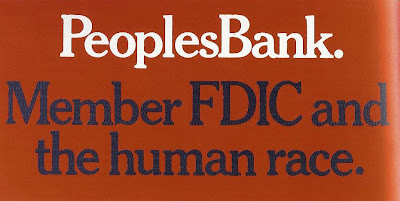
Back in the '70s and '80s, it was all the rage for banks to emphasize their humanity. Maybe it had something to do with our post-Vietnam, post-Watergate loss of faith in our institutions and the rise of the impersonal corporate culture; or maybe it was just the effect of decades of media portrayals of cold-hearted bankers, from Mr. Potter to Mr. Mooney.
"One of the strongest human instincts is to want to make sense of what we see. We are intrigued by the unexpected and don't like being left with a mystery...we are drawn in to solve the visual riddle or to read the copy in search of an explanation."The question, of course, is how long the average reader will keep searching. That's the fine line you walk in ads like these. If fact this one has a double riddle. Once you realize the bunched-up magazines are forming the image of a brain, the question becomes, "What magazine would claim to be such brain fodder?"Update 5/6: New to my site? Here's some previous posts worth checking out:
Labels: Ads, Creativity
Labels: Ads