Posts

Meet The Unswitchables
Image
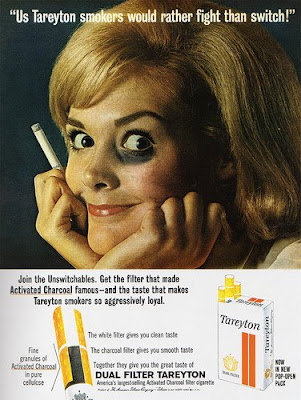
Mangled grammar aside, you gotta give Tareyton Cigarettes 1963 campaign points for chutzpah: With the competition of cigarette brands heating up, Tareyton's slogan was designed to push the loyalty of their smokers. The words, though, would probably have not as been as effective had they not been accompanied by the photos of proud Tareyton smokers -- both men and women -- sporting black eyes.   (Yes, it was just makeup, but even so, looking back with forty-five years of hindsight, it's still hard not to look at the above image and think of domestic violence.  It probably occurred to some readers back then, too -- though few people probably voiced any concerns publicly.) By the way, the same ad man who gave us this admittedly clever mnemonic -- James Jordan , who died a couple of years back -- also was behind Wisk's well-remembered (if screechy) "Ring around the collar" slogan.  Ring around the collar.  Ring around the eye.  I sense a pattern here. TV spots turned ...

A real Swinger

I liked this spot when it first ran in 1965 and, seeing it again after 40-plus years, I have to marvel at the multiple audiences the spot courts simultaneously. First of all, we start with a gal sauntering in a bikini bottom, guaranteed to appeal to youth and middle-aged men alike (each group naturally interested in swinging, though perhaps in different meanings of the word).  Then there's the guitar heavy jingle, contemporary enough for the kids, but middle-of-the-road enough for mom and dad -- and irresistibly catchy with the female singers' yeah-yeah's and their repetition of the product name.)  And just when you think the spot is just getting a little too wholesome in its depiction of modern teens, here comes the musical bridge for some jangly rock-and-roll, wild dancing and lots of cavorting on the beach (with a big "YES" as one couple is photographed getting friendly in the sand).  Then the whole thing is wrapped up with an all-ages romantic shot of a couple...

Shuffle

Image
Following the release of the mariachi-influenced band's 3rd album, released in 1964, Herb Alpert and the Tijuana Brass soared to new heights of popularity, selling millions of albums and cementing their place in popular music.  And of all the songs on the album, the best-remembered is surely "The Mexican Shuffle." But it's not remembered as that:

Swiping Peanuts

Image
Around 1959, amid the first wave of "Peanuts" merchandising (whose millions in profits would forever change how the business of comic strips), Ford came to creator Charles Schulz with a lucrative offer of an annual licensing fee in return for Charlie Brown and company to serve as "spokeskids" for their new Falcon model.   Under Schulz's close supervision, Ford gave the Peanuts characters their first TV exposure in animated spots like this one from 1964: The awkward, stilted dialogue is of course, a horrible fit with the cast, with none of the substance, easy verbosity and wit of future productions like "A Charlie Brown Christmas."  But it worked well enough to help the Falcon become a huge success for Ford. When some newspaper industry professionals accused Schulz of excessive profiteering, he responded this way (as detailed in his recent biography ): "The duty of the comic strip is to bring readers to the newspaper as a whole... If that is not f...

Maidenform exposed

Image
According to ad lore, Maidenform's "Dream" campaign was launched in 1949 in response to a study that found that women had "exhibitionist tendencies."  To say nothing of a pre-women's liberation desire for traditionally male-dominated occupations.  These women just never seemed to show up at church or the PTA meeting in their skivvies. By the 1960s, the ads got more fanciful, more punny and even more less self-conscious: These women weren't just dreaming about exposing themselves in public, now they were reveling in it. The campaign went dormant in 1971, but eight years later, it returned, this time balancing the outrageousness of the scenario with a steely, no-nonsense woman.  It managed to turn what was previously a girlish fantasy into a bizarre statement of female empowerment. ...but one that just helped prepare us for this lady in the coming decade: Yes, "I dreamed I was a world-famous, envelope-pushing pop star...in my underwear."

Context is everything

Image
That's probably as good as explanation as any of why nobody remembers this Kotex ad from 1970: But for those who were around in 1975, this is unforgettable: (Quick remedial history lesson here , if you need it.) Elsewhere:  Check out AdBroad for her answer to the inevitable question, "How can I work in advertising?"

Behind the Foster Grant campaign

Image
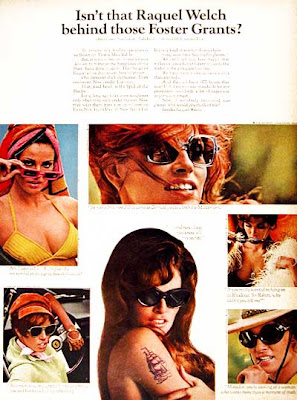
In 1965, Foster Grant, then the leading U.S. marketer of moderately priced sunglasses, debuted the campaign that would earn it the 68th spot on Advertising Age's Top 100 Brands of the 20th century: Although known as the "Who's That Behind The Foster Grants" campaign, that actually wasn't the headline that appeared in the ads: No real mystery here, is it?  But if you read the copy, you'll see that surprise wasn't really the point: "...our Foster Grant sunglasses have done it again.  They've given Raquel a new dimension.   Several in fact.   One moment she's capricious.  Then contented.  Now candid.  Even coy." Captions under the photos are meant to exemplify her many moods; mostly they're just silly, but the one under Raquel in a bikini top seems prescient: "Am I doomed, C.B., to play the sex symbol in an age of flower children?" ("C.B." seems to refer to Cecil B. DeMille, the producer/director known for his star-st...