We referenced this ad campaign in an earlier post , but it really deserves its own entry. This memorable/notorious American Airlines campaign appeared back in 1971, at the behest of National Airlines' Lewis Maytag who sought to modernize the airline and the image of its stewardesses. (Yes, they were still known as stewardesses back then.) At the time, airline advertising had frequently based their messages on the friendliness and attentiveness of their stewardesses, but previous efforts tended more toward the chauvinistic end of sexism spectrum, treating them more like Ladies Of The Air than ladies of the night: (Despite the caveman ethos of the headline and illustration, if you click on the ad to enlarge it and read the copy, you'll see it's actually about men being so beguiled by their stewardesses that they often took them for wives -- after first mistaking wives for servants, I suppose.) But now, with the sexual revolution and women's liberation in full swing (an...
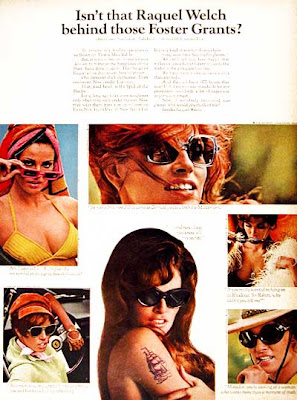
In 1965, Foster Grant, then the leading U.S. marketer of moderately priced sunglasses, debuted the campaign that would earn it the 68th spot on Advertising Age's Top 100 Brands of the 20th century: Although known as the "Who's That Behind The Foster Grants" campaign, that actually wasn't the headline that appeared in the ads: No real mystery here, is it? But if you read the copy, you'll see that surprise wasn't really the point: "...our Foster Grant sunglasses have done it again. They've given Raquel a new dimension. Several in fact. One moment she's capricious. Then contented. Now candid. Even coy." Captions under the photos are meant to exemplify her many moods; mostly they're just silly, but the one under Raquel in a bikini top seems prescient: "Am I doomed, C.B., to play the sex symbol in an age of flower children?" ("C.B." seems to refer to Cecil B. DeMille, the producer/director known for his star-st...
Concluding our look at the hits and misses during the seminal years of Avis' famous "We Try Harder" campaign. Throughout the initial "We Try Harder" campaign, Avis avoided any mention of who was #1 to their #2 status. Everyone knew who #1 was, of course, and back then, it was almost unheard of for any company to name their competitors. It may also have had something to do with knowing that, with its much larger ad budget, Hertz could squash Avis in any direct competition. This ad, coming late in the campaign, was one of the more obvious, though still veiled, references to their larger rival: If you were watching TV back in the mid 1960s, you'd get the reference. If not, here's a typical Hertz spot from that era. Watch for the visual mnemonic at the end: "I feel all we have done is awakened a sleeping giant," Japanese Admiral Isoroku Yamamoto is reputed to have said following the attack on Pearl Harbor. Whether Hertz was sleepwalking th...



Comments